
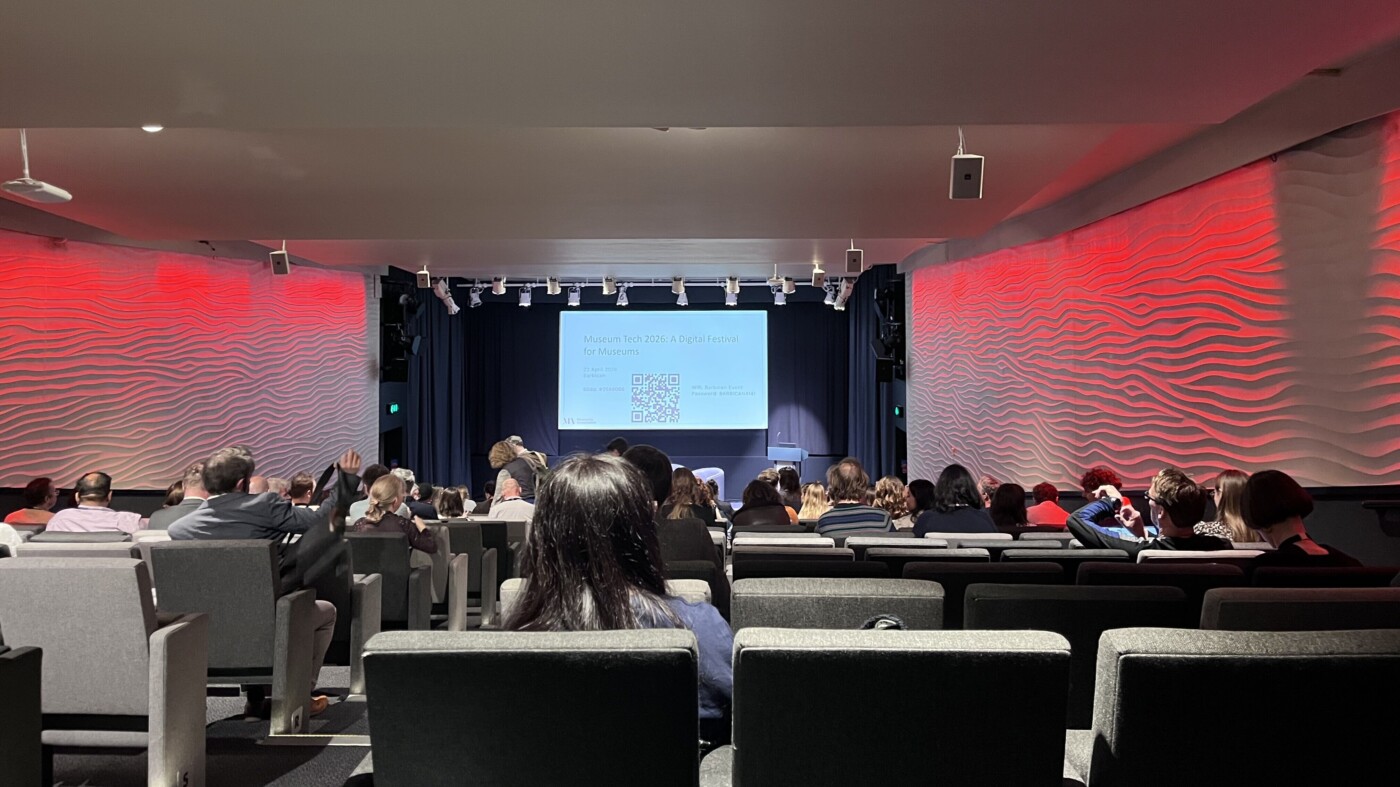
I attended a series of talks from the Museums Association exploring the role of technology in museums. It was held at the Barbican, which felt like a glorious and radical setting for conversations around AI.
Ash Mann opened with a provocation on why digital and AI projects so often fail to get off the ground. This set the tone for a series of honest, practical talks from museums tackling the thorny issue of digital delivery. Some focused on front of house experiences, others on process or CRM delivery. Each speaker shared how they approached specific projects and the different perspectives required to make progress.
The top five takeaways were:
1. Experiment, experiment, experiment
There’s a strong desire to create perfect museum projects, driven by responsibilities around funding, process, and presenting collections in a factual and educational way. These accountabilities carry heavy weight. But speaker after speaker emphasised the importance of experimentation. Creating room to test and learn can foster visitor ownership and does not have to require large budgets or result in wasted effort.
2. Start with people
Not just audiences, but colleagues and collaborators too. Ash Mann noted many projects fail because of human messiness. Kati Price at the V&A spoke about understanding the wider digital ecosystem, from influencers to online behaviours, and using those insights to shape physical experiences. Their work with young bloggers is a strong example of this in action.
At the Black Country Living Museum, Sam Davies explained that projects begin with people and outcomes, not process. Joe Vaughan from MERL also made a compelling case for supporting social media teams navigating an ever changing and demanding landscape.
3. Find your purpose and design for discoverability
All the speakers stressed the importance of identifying a project’s purpose and holding onto it throughout its life. Sam Davies spoke about finding your North Star early and using it to guide decisions, even in procurement. At the same time, there was a recognition that with AI in particular, outcomes cannot always be predicted.
4. Stories are a museum's superpower
Museums are built on stories, sometimes unexpected ones. As Joe Vaughan put it, sometimes these stories are about sheep, and are constantly imitated by other content creators. Stories offer endless ways to connect people with spaces.
Kati Price also highlighted the role of relatability to a changing visitor profile, and how digital content can use emotion and human connection to draw people back into physical environments.
5. Trust is still foundational
During the panel discussion, it was clear that museums begin with facts, objects and evidence. Interpretation is what opens these up to audiences. While AI may enable more personalised engagement and satisfy curiosity in different ways, it does not replace the authority of the object or the truth it represents. Trust remains central.
My reflections from a wayfinding perspective
What stood out most is how closely this thinking aligns with wayfinding.
Wayfinding is about understanding the visitor journey, gaining a real understanding of the user ecosystem to remove friction, support navigation, and help people make sense of place.
Museums, through AI and digital, are doing something very similar: unpicking the visitor journey to better understand what drives people’s connection to place and how to create meaningful engagement.
The tools may differ, but we are not so different in what we’re trying to achieve.
Finally, what really struck me was the passion. The passion for the sector, for experimentation, and for evolving the museum experience to better serve a 21st-century museum visitor, while creating a valuable legacy for generations to come.